Industry News
The ancient floating bridge is as picturesque as a dream in the morning light
Edited by: Guangzhou Deli Yacht Terminal Engineering Co., Ltd
Edited on: May 6, 2016
The ancient city of Ganzhou is surrounded by three major rivers: Zhangjiang, Gongjiang, and Ganjiang. There used to be a moat to the south, which is a; Fuzhou;. This geographical location is very inconvenient for people to enter and exit Ganzhou City. Since the Song Dynasty, the economy of Ganzhou has developed rapidly, commercial trade has become increasingly prosperous, and merchants have frequent exchanges. In order to communicate the connection between Ganzhou City and the outside world, facilitate the transportation of people and goods, Ganzhou has successively erected floating bridges on the two rivers of Zhanggong. Ganzhou began to build floating bridges on the two rivers of Zhanggong during the Song Dynasty to facilitate the transportation of people and goods.
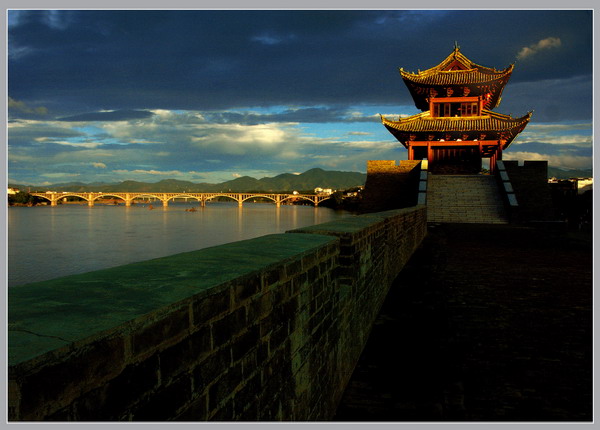
We know that the earliest floating bridge built in Ganzhou was the Xijin Bridge located outside Xijinmen on the Zhangjiang River. That was built during the Xining period of the Northern Song Dynasty (1068-1077 AD) under the leadership of Liu Jin, the governor of Ganzhou. The floating bridge no longer exists, but according to the teacher, it was still in use more than twenty years ago. Our parents and ancestors have walked on that floating bridge.
The second floating bridge in Ganzhou was erected by the Zhijun Hong Mai on the Gongjiang River during the Qiandao period of the Southern Song Dynasty (1165-1173 AD); Huimin Bridge;. This bridge was later renamed Dongjin Bridge, which is now known as Jianchunmen Floating Bridge.
Hong Mai, who presided over the construction of the Jianchunmen Floating Bridge, was a famous writer of the Southern Song Dynasty and a historical figure with national integrity. When he was representing the imperial court on a mission to the Jin dynasty, the Jin people demanded that he perform the etiquette of a courtier. However, he refused to obey and the Jin people locked him up in the embassy without food or drink, leaving him hungry for three days and three nights. He would rather starve to death than uphold national dignity, and the people of Jin had no choice but to release him.
Hong Mai was knowledgeable and wrote a large number of works covering history, literature, philosophy, art, and other fields throughout his life. Among them, the most famous is his "Rongzhai Essays", which is still a bestseller to this day Later, the Southern Song Dynasty sent Hong Mai to Ganzhou as the military governor. According to historical records, after he came to Ganzhou to become an official; Pay attention to education, build study halls, construct floating bridges, and facilitate the people; Received high praise from the people.
Today, walking on the Jianchunmen floating bridge built by Hongmai, we all admire this ancient literary figure who can do practical things for the people. &Nbsp;
The third floating bridge in Ganzhou was the Nanhe Floating Bridge erected by the Zhijun Zhou Bizheng on the Zhangjiang River outside the South Gate during the Chunxi period of the Southern Song Dynasty (1174-1189 AD). The Nanhe Floating Bridge was in use until 1990, until it was dismantled after the completion and opening of the Nanhe Bridge in Ganzhou City.
The three ancient floating bridges in Ganzhou were all built during the Song Dynasty and have been in use until modern times. They not only played a huge role in connecting urban and rural transportation, but also played a role in; Suojiang; The function. The ancient city of Ganzhou had; Gan Guan; Collect taxes on passing merchant ships, open floating bridges at regular intervals, and allow passing merchant ships to pass only after inspecting tax receipts. Now, every morning at 9am and afternoon at 4pm, the Jianchunmen floating bridge still opens regularly to facilitate the passage of ships.
The ancient floating bridge in Ganzhou is another scenic spot among the many famous historical sites in Ganzhou. Every year, a large number of tourists from home and abroad come here to sightsee and witness this unique cultural landscape of Ganzhou. In 1965, when Guo Moruo came to Ganzhou, he wrote a poem:; The Three Rivers flow day and night, the Eight Realms are magnificent and majestic, the clouds are lined up in Guangxia, and the Long Bridge floats on the water;. Nowadays, the urban transportation environment in Ganzhou has become increasingly perfect. Apart from the Jianchunmen floating bridge which is still in use, the Nanhe floating bridge and Xijinmen floating bridge no longer exist. However, the people of Ganzhou will always remember these three floating bridges, which are witnesses to Ganzhou's long history and culture.