Industry News
What are the advantages and disadvantages of floating water photovoltaics?
Edited by: Guangzhou Deli Yacht Terminal Engineering Co., Ltd
Edited on: October 14, 2017
Source: Internet
Floating water photovoltaics refer to the establishment of floating photovoltaic power stations on water bodies such as ponds, small lakes, reservoirs, and reservoirs to solve the problem of large land occupation in traditional photovoltaic power generation. The hardware components of a floating water photovoltaic power station mainly include photovoltaic panels, combiner boxes, inverter equipment, transformers, collection lines, polyethylene floating body platforms, etc.
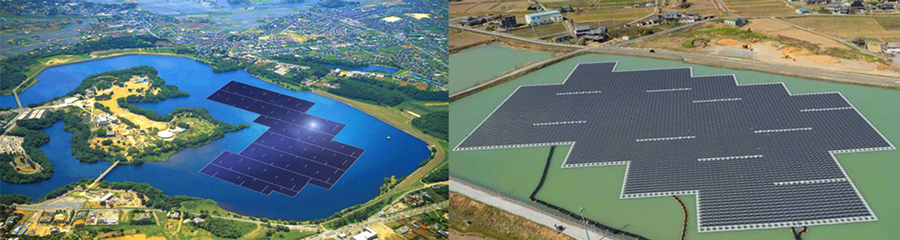
Currently, Japan, India, Brazil, and some European countries are vigorously developing floating water photovoltaics, while China started relatively late but is also working on developing such projects. Below are some advantages and disadvantages of floating water photovoltaics compared to conventional land-based photovoltaics.
Floating water photovoltaics have the following advantages:
① Land conservation: Built on the water surface without occupying land resources, it can reduce land acquisition costs.
② Increasing power generation: Water has a cooling effect on photovoltaic modules, which can suppress the surface temperature rise of the modules and thus achieve higher power generation. According to the comparative analysis of large-scale water-based photovoltaic power plants in Hyogo Prefecture, Japan, due to the cooling effect of the water surface, the power generation of the solar panels increased by about 14%.
③ Reduce evaporation and algal growth: Covering solar panels on the water surface theoretically can reduce the amount of water evaporation, suppress algal growth in the water, and benefit the protection of water resources.
④ Easy operation and maintenance: The photovoltaic power station is built in water, which can reduce dust pollution to the components and facilitate component cleaning. At the same time, it is difficult for idle personnel and animals to access the components, which can effectively prevent personnel and animals from damaging the components.
⑤ Tourism benefits: The neatly arranged photovoltaic modules on the vast water surface can serve as a distinctive attraction and become a landscape in the area, bringing tourism benefits.
⑥ Avoiding component shading: Compared to land, the water surface is relatively open, which can effectively avoid the obstruction of components by mountains, forests, etc. The solar energy irradiation area is uniform and the lighting time is long.
⑦ Reduce tracking system costs: Consistent component angles and spacing facilitate the installation and operation of solar tracking systems, without the need to install dual axis tracking systems on each solar panel, greatly reducing tracking system costs.
⑧ Cost saving: No need for component foundations and brackets, saving on foundation and bracket costs, and reducing costs.
⑨ Convenient consumption: Built in water bodies close to villages and cities, it can be consumed nearby, reducing unfavorable factors such as grid connection difficulties and power restrictions, and improving efficiency.
Floating water photovoltaics also have some disadvantages:
① High requirements for floating equipment: Floating water photovoltaics require floating equipment to support photovoltaic panels, and the floating platform has high requirements for corrosion resistance, low density, frost resistance, wind and wave resistance, lifespan, and load-bearing capacity.
② High site selection requirements: Floating water photovoltaic power plant sites should be selected in water areas with a wide area, stable runoff, low wind speed, good lighting conditions, small water level changes, good development conditions, no large-scale shipping, and non sensitive ecological areas.
③ There are many uncertain factors: strong winds, water levels, ice formation, and other factors have a significant impact on it. At the same time, it is necessary to monitor whether photovoltaic modules have adverse effects on water quality, fish, plants, and other aquatic organisms.
④ Difficulty in construction: The construction process requires consideration of many factors, and it is difficult to use heavy machinery and other equipment for efficient construction in water operations. There are relatively more process requirements, and the construction period also increases accordingly. There are many tasks that require diving or working on board. On board operations should consider balance and safety, and facilities such as water tanks and dams should not be damaged.